12 Extraordinary Wooden Planter Designs That Redefine Outdoor Elegance
In an era where urban landscapes compete with nature for breathing room, wooden planters emerge as quiet revolutionaries. They are not mere containers for soil and roots; they are sculptural statements that marry craftsmanship, sustainability, and botanical beauty. Crafted from reclaimed hardwoods, weathered teak, or precision-milled oak, these 12 designs—spanning minimalist geometry to organic abstraction—prove that a planter can be as much a work of art as the greenery it cradles. Whether framing a corporate plaza, softening a rooftop edge, or anchoring a private courtyard, each piece in this curated collection tells its own story of texture, form, and function. Over the next 2,000+ words, we’ll dissect every facet: the grain that catches golden hour light, the joinery that defies decades of weather, and the plant pairings that transform wood into living architecture.

Design 1: The Stacked Horizon Trough
Behold the quiet authority of horizontal layering. This elongated planter is built from thick, kiln-dried iroko planks stacked in a rhythmic 3:1 ratio—three wide boards to one narrow cap—creating a bold, banded effect that reads like topographical lines on a map. The slight overhang of each layer casts micro-shadows, adding depth even when unplanted. At 240 cm long, 60 cm wide, and 75 cm tall, it commands space without overwhelming it.
The wood’s natural oils repel water, while hidden stainless-steel liners prevent root rot and soil bleed. Drainage is handled by a discreet channel system that routes excess water to a recessed reservoir, allowing for drought-tolerant succulents or lush herb cascades alike. In the image, purple basil and lime-green creeping Jenny spill over the edges, their colors popping against the wood’s caramel patina.
Why it works: The trough’s scale turns a row of three into a living wall, ideal for delineating pedestrian paths in commercial settings (think tech campuses or boutique hotel forecourts). Its low profile keeps sightlines open, while the stacked design invites tactile exploration—fingers naturally trace the seams. Plant pairing tip: Alternate heights with trailing rosemary, upright lavender, and compact boxwood for year-round structure. Durability note: Iroko’s density rivals teak; expect 25+ years with minimal maintenance beyond annual oiling.
Design 2: The Faceted Boulder Trough
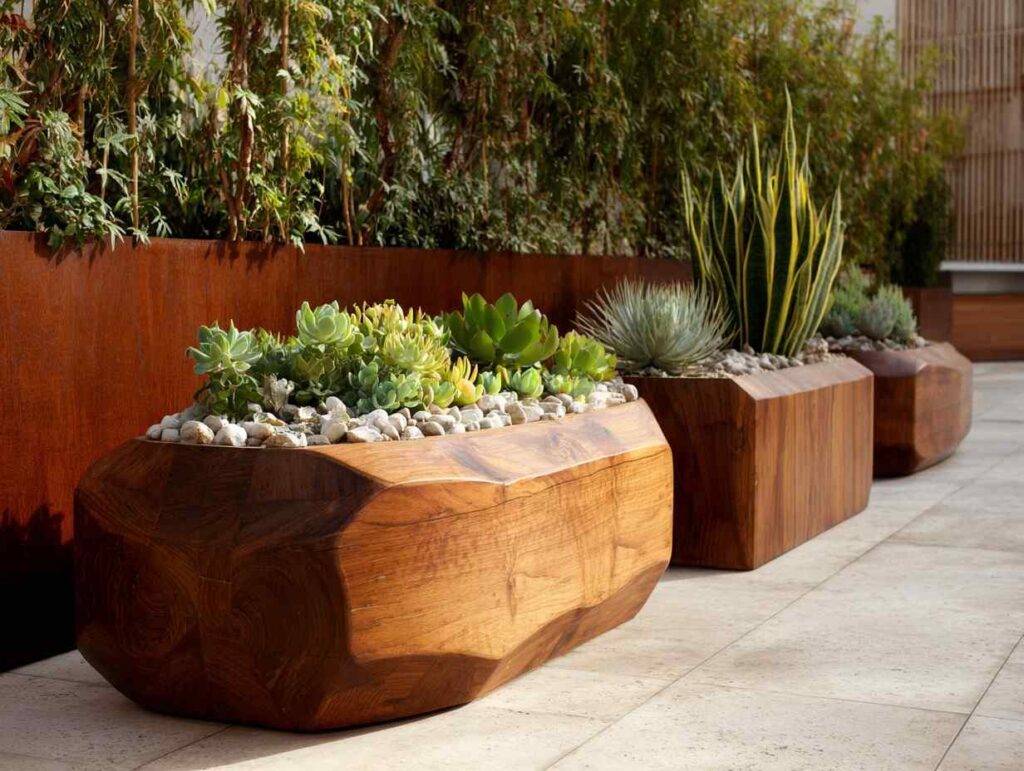
Where raw geology meets refined carpentry. This low-slung, monolithic planter mimics a river-worn stone pulled from ancient bedrock—except it’s hand-carved from a single slab of sustainably sourced cumaru (Brazilian teak). Each face is chiseled into irregular polygons, then sanded to a satin finish that reveals swirling grain like topographical maps. The top edge dips and rises in a gentle wave, creating natural pockets for drainage and planting zones. At 180 cm long, 55 cm wide, and just 40 cm tall, it hugs the ground, inviting moss to creep along its flanks.
The interior is lined with a breathable geotextile membrane and a false bottom that lifts roots 8 cm above a hidden reservoir—perfect for succulents that dread wet feet. In the photo, a miniature desert-scape thrives: Echeveria ‘Black Prince’ clusters in the deepest facet, Agave victoriae-reginae spears upward from the center, and Sedum rupestre ‘Angelina’ spills golden needles over the edge onto white Dolomite pebbles. The contrast is electric—cool blues and silvers against the wood’s ember-red heart.
Why it works: The boulder’s organic silhouette softens hard-edged modern terraces, especially when juxtaposed with Corten steel (as shown). Its faceted surfaces fracture sunlight into a kaleidoscope of shadows, animating the space from dawn to dusk. Group three in a staggered line to mimic a glacial moraine, or use a single unit as a sculptural coffee-table proxy on a rooftop. Plant pairing tip: Lean into xeriscape drama—pair with Dasylirion wheeleri, Yucca rostrata, and trailing Senecio serpens for a living Rothko painting. Durability note: Cumaru rates 3,500+ on the Janka hardness scale; it laughs at termites and laughs harder at UV rays. A biannual coat of penetrating oil keeps the color from silvering for 15–20 years.
Design 3: The Charred Cube Tower
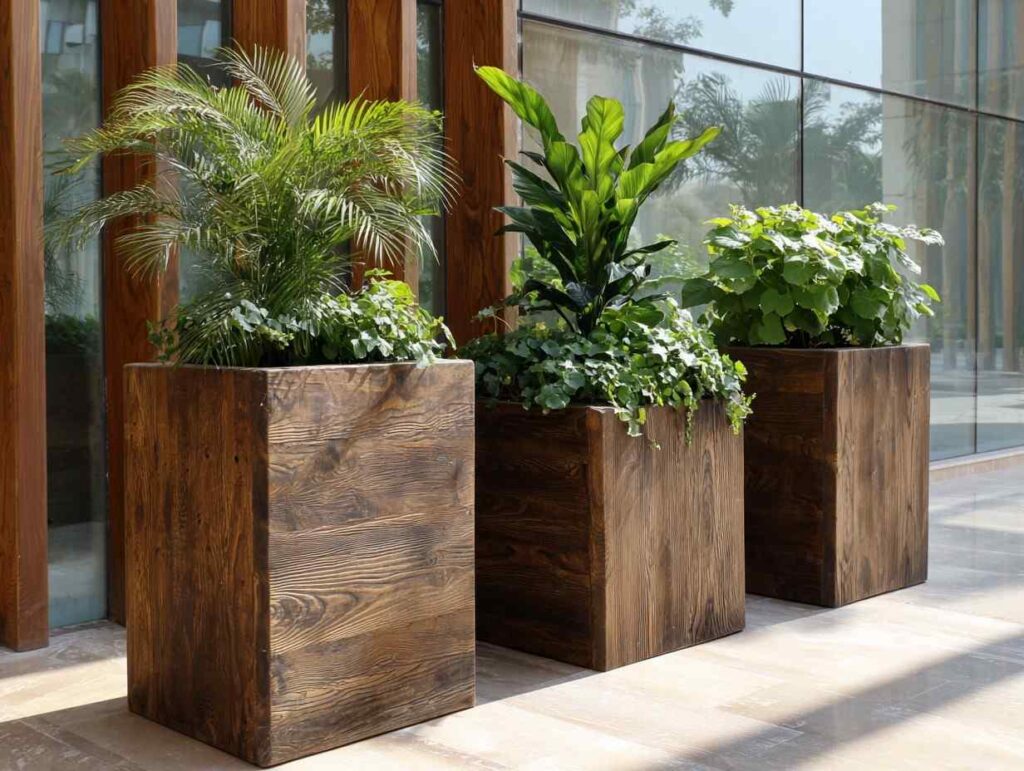
A study in controlled imperfection. These tall, square planters are forged from reclaimed Japanese shou sugi ban cypress—ancient beams rescued from deconstructed tea houses, then re-milled into 75 cm × 75 cm × 120 cm monoliths. The traditional yakisugi charring technique blackens the surface to a crocodile-skin texture, then wire-brushed to reveal raised silver grain that glimmers like moonlit charcoal. The burn not only preserves the wood (fungi and insects flee the carbonized layer) but creates a velvety, almost obsidian finish that drinks light during the day and glows under evening uplighting.
Inside, a galvanized steel insert sits 15 cm below the rim, creating a hidden water reservoir for sub-irrigation—ideal for tropicals that crave consistent moisture without soggy roots. The photo showcases a trio flanking a glass entrance: the left cube cradles a Chamaedorea seifrizii (bamboo palm) with Pilea peperomioides spilling like coins at its feet; the center hosts a Dracaena ‘Lemon Lime’ flanked by Peperomia obtusifolia; the right overflows with Epipremnum aureum (pothos) cascading 60 cm down the charred face. The lush emerald foliage against the matte black is pure drama.
Why it works: The 1.2-meter height creates instant architecture, framing doorways or dividing open-plan lobbies without permanent walls. The charred surface hides scuffs and fingerprints, making it bulletproof for high-traffic zones (think hotel lobbies or co-working atriums). Cluster four in a 2×2 grid for a living sculpture, or stagger heights (60 cm, 90 cm, 120 cm) for a skyline effect. Plant pairing tip: Embrace the jungle vibe—pair with Philodendron ‘Birkin’, Calathea orbifolia, and Fittonia for a biophilic boardroom. Durability note: Shou sugi ban is essentially fossilized wood; the charred layer acts as a natural cladding. Expect 50+ years outdoors; the interior cypress core remains untouched by rot.
Design 4: The Vertical-Ribbed Sentinel
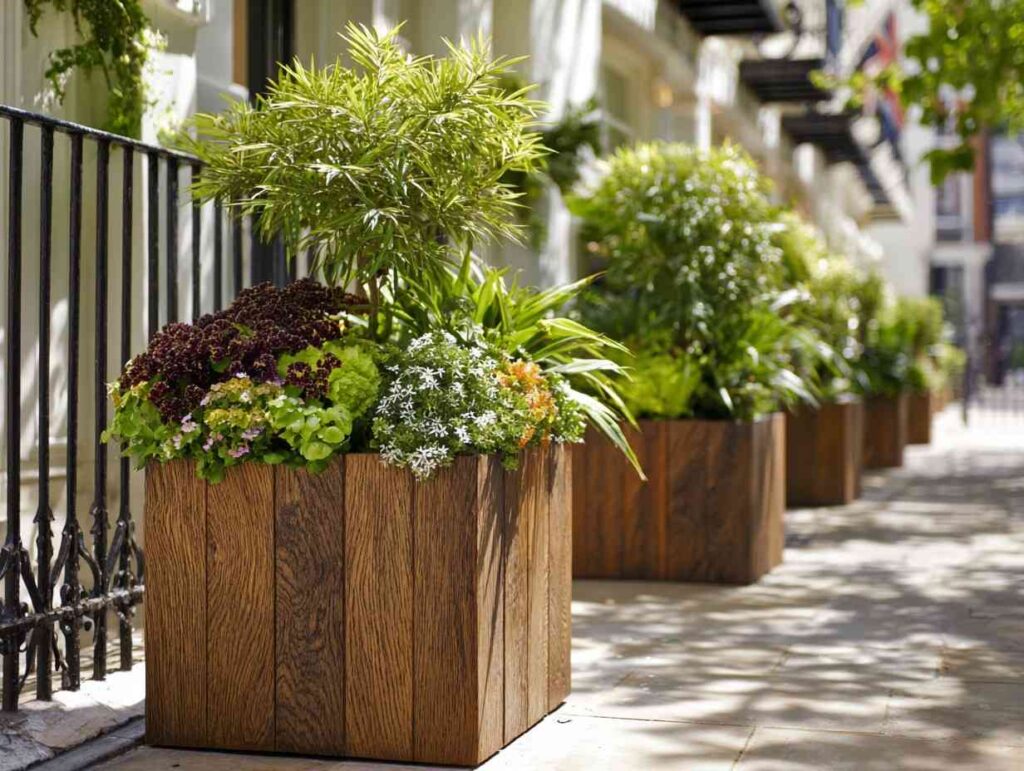
Precision meets patina in this street-side phalanx. Fashioned from quarter-sawn European oak, each planter is a 60 cm × 60 cm × 90 cm cube wrapped in 2 cm-thick vertical slats spaced 3 mm apart—tight enough to contain soil, wide enough for air to whisper through. The ribs are steam-bent at the corners for a seamless, armor-like sheath, then left raw to weather into a silvered cloak that mimics aged ship planking. Hidden dowels and marine-grade epoxy lock the frame; no metal touches the earth.
A removable HDPE liner floats 10 cm above an integrated saucer, fed by capillary wicks that self-regulate moisture—perfect for the forgetful urban gardener. In the image, a curbside parade marches past Georgian townhouses: the foreground sentinel erupts with a Podocarpus macrophyllus standard underplanted with Heuchera ‘Palace Purple’, Euphorbia ‘Blackbird’, and Carex ‘Everillo’. The vertical lines elongate the cube, turning a modest 90 cm into a 2-meter visual pillar when the topiary matures.
Why it works: The ribbed texture is a fingerprint magnet in the best way—rain streaks it, sun bleaches it, and ivy eventually threads the gaps like green stitching. Line ten along a sidewalk to create a rhythmic green colonnade that slows traffic and frames storefronts. The oak’s tannin content naturally repels pests; pair with LED strip uplighting recessed in the base for nocturnal theater. Plant pairing tip: Go vertical—train Thunbergia alata (black-eyed Susan vine) up a hidden trellis inside, or top with clipped Buxus sempervirens cones for a formal parterre. Durability note: Quarter-sawn oak shrinks less than 0.5 % radially; the ribbed design sheds water like a duck. Expect 30+ years before the silver patina demands nothing but admiration.
Design 5: The Fractured Prism Cube
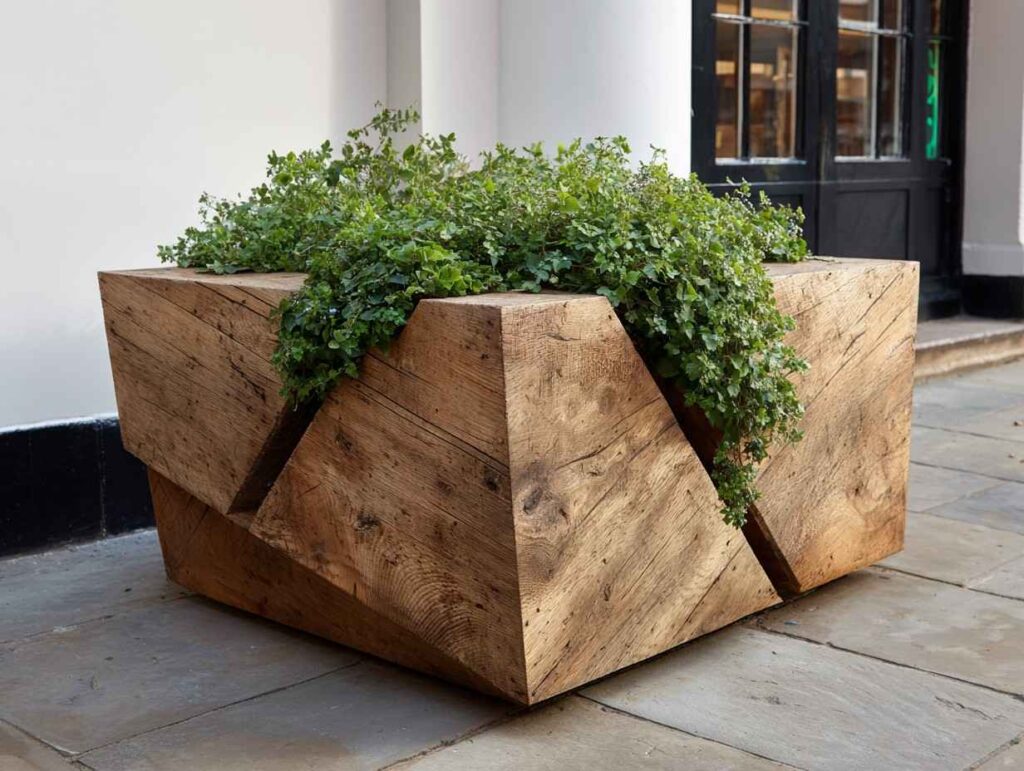
Geometry gone rogue. This 70 cm × 70 cm × 55 cm cube appears to have been struck by lightning and reassembled by a poet. Crafted from century-old reclaimed English oak railway sleepers, the planter is sliced into four asymmetrical wedges that tilt inward like a collapsing diamond, then locked together with concealed carbon-fiber pins. The top surface splits into a jagged “X,” creating four triangular planting pockets that converge at the center—each pocket 25 cm deep, lined with copper mesh to deter slugs and allow micro-drainage. The wood is left untouched: knots, saw marks, and tar stains tell a century of stories, while the fissures collect rainwater like tiny reflecting pools.
In the photograph, a single specimen stands sentinel outside a Mayfair gallery. A riot of Origanum vulgare ‘Aureum’ (golden oregano) explodes from the fissures, its chartreuse tendrils licking the oak’s weathered cheeks. The low height keeps the focus on texture; the plant mass barely clears 30 cm, yet the drama is monumental.
Why it works: The fractured form is pure conversation—passersby stop, tilt their heads, and trace the cracks with their eyes. It’s brutalist sculpture meets functional horticulture, ideal for minimalist courtyards or as a lone statement on a gravel terrace. The four pockets encourage “one plant per facet” discipline: try Thymus citriodorus, Sempervivum ‘Rubin’, Mentha requienii, and Viola odorata for a living herb mosaic. Plant pairing tip: Embrace the cracks—let Saxifraga stolonifera root into the gaps for a perpetual green waterfall. Durability note: Railway oak was pressure-treated with creosote in the 1920s; the tannins have polymerized into stone-like hardness. This planter will outlive the building it guards—50 years is just the warm-up.
Design 6: The Chevron-Folded Vessel
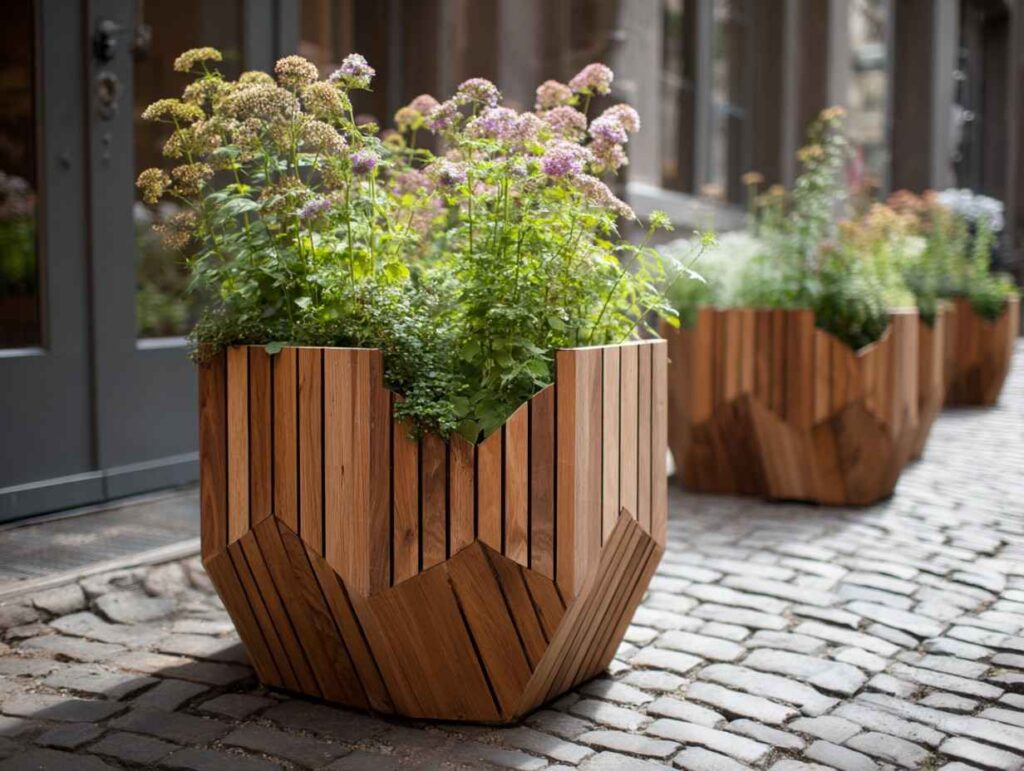
Origami in hardwood. This 65 cm tall, 50 cm diameter planter is a tessellated marvel—crafted from 28 precisely mitered teak staves, each 4 cm wide, folded into a rhythmic chevron pattern that zigzags upward like a pinecone. The facets alternate between vertical and 45-degree angles, creating a faceted crown where two V-shaped notches dip 12 cm below the rim—perfect for cascading plants to spill through like green waterfalls. The base tapers to a 35 cm footprint, giving it a deceptive lightness despite weighing 48 kg. Hidden brass screws and tongue-and-groove joinery vanish into the grain; the only visible metal is a discreet drainage grommet disguised as a knot.
The interior features a double-walled system: an inner aluminum cylinder (anodized matte black) sits inside the teak shell, thermally isolating roots from summer scorch and winter freeze. A 3 cm air gap acts as passive insulation, while a capillary mat at the base wicks water from a 2-liter hidden reservoir. In the photo, a cobblestone alley hosts a trio: the lead vessel erupts with Sedum album ‘Coral Carpet’ threading the notches, crowned by Achillea millefolium ‘Lilac Beauty’ in soft mauve umbels. The chevrons catch late-afternoon light like stained glass, casting arrow-shaped shadows on the stones.
Why it works: The folded geometry turns a static pot into a dynamic sculpture—spin it 360° and the pattern shifts like a kaleidoscope. The V-notches are genius: they frame trailing plants (Helichrysum petiolare, Lobelia erinus) while hiding drip lines for automated irrigation. Cluster five in a pentagon for a living chandelier under a pergola, or flank a doorway in pairs for symmetrical drama. Plant pairing tip: Play with the folds—plant upright Salvia nemorosa ‘Caradonna’ in the high facets and let Campanula poscharskyana weep from the lows. Durability note: Teak’s 1,000+ silica content makes it naturally rot-proof; the chevron design sheds water like a lotus leaf. With annual oiling, it’ll outlast the cobblestones—easily 40 years.
Design 7: The Modular Mosaic Stack
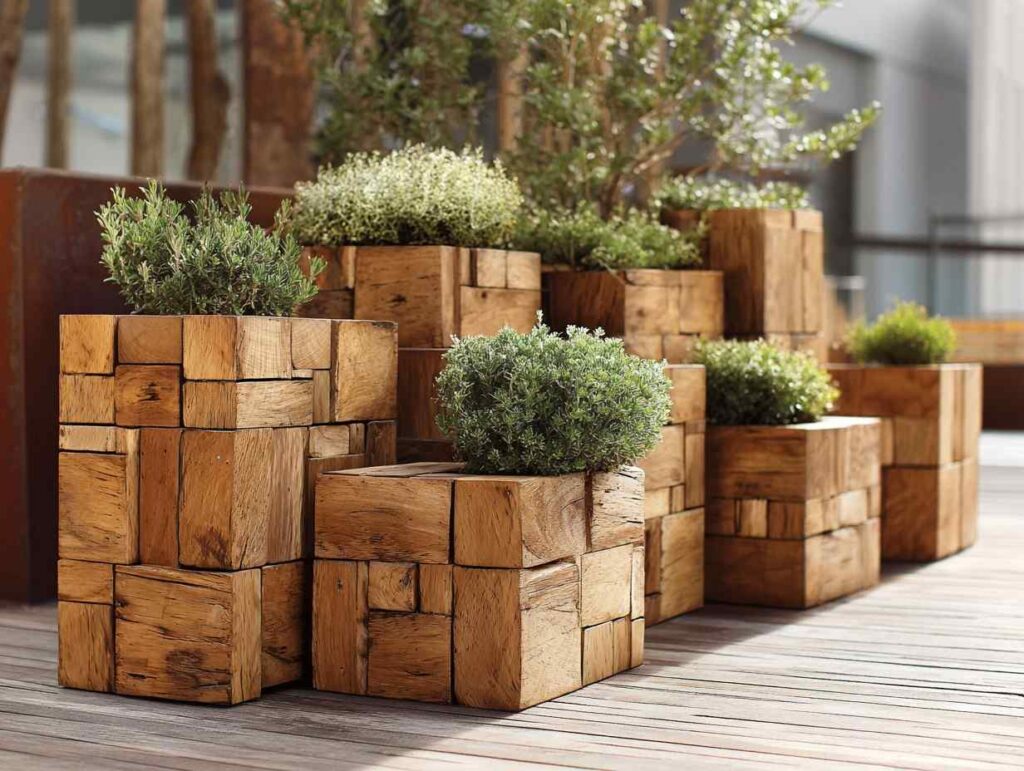
Lego for landscape architects. This system transforms reclaimed elm dockyard beams—salvaged from 19th-century London wharfs—into 20 cm × 20 cm × 20 cm cubes, each face a pixel of golden-brown history. The blocks are dovetailed and glued with waterproof resorcinol, then stacked without fasteners into towers, walls, or sculptural clusters. A hidden stainless-steel rod threads through pre-drilled cores for stability in wind; the tallest configuration in the photo reaches 180 cm (9 cubes high) yet disassembles in minutes for seasonal redesign. Each cube has a 15 cm deep planting well lined with breathable coco-coir, and a 1 cm drainage hole that aligns vertically to create a continuous water column—no saucers needed.
The image captures a rooftop bistro tableau: a stepped pyramid of 28 cubes hosts a Mediterranean herb garden. Lavandula angustifolia ‘Hidcote’ crowns the apex, Santolina chamaecyparissus tumbles down the slopes, and Thymus vulgaris ‘Compactus’ fills the lower tiers. The irregular grain and wormholes catch honeyed evening light, turning the stack into a glowing honeycomb.
Why it works: The modularity is addictive—start with six cubes for a side table, expand to 50 for a living room divider. The 1:1 ratio ensures perfect Instagram geometry, while the reclaimed elm’s density (720 kg/m³) shrugs off rooftop gusts. Rotate cubes seasonally to refresh planting faces or to hide winter die-back. Plant pairing tip: Treat each cube as a micro-climate—sun-loving Rosmarinus officinalis ‘Prostratus’ on south faces, shade-tolerant Mentha spicata in the shadows. Durability note: Elm was once ship keel material; these beams survived tidal submersion for a century. With UV-protective oil every two years, the stack will outlast the decking—40–60 years of reconfiguration bliss.
Design 8: The Polyhedral Cloud Cluster
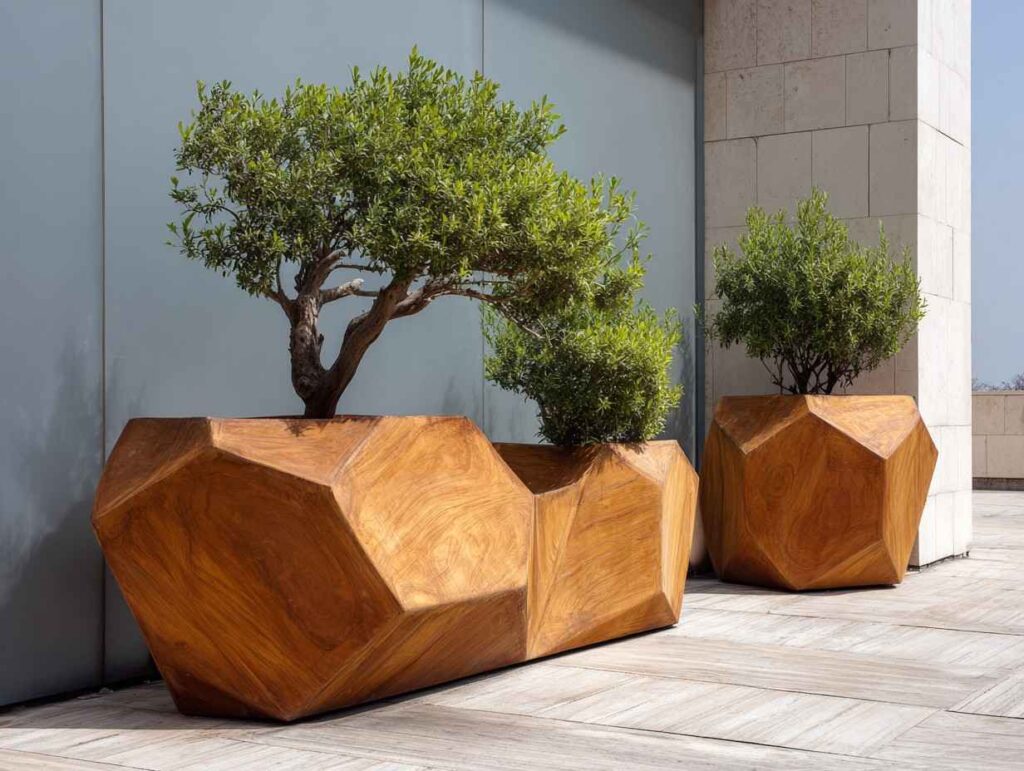
Sculpture that defies gravity. This interlocking duo—crafted from FSC-certified Burmese teak milled into 12-sided dodecahedrons—appears to float against the wall like amber clouds caught mid-drift. The larger unit (140 cm long × 60 cm deep × 70 cm tall) is bisected into two conjoined polyhedrons, each face a 22 cm equilateral triangle beveled at 8°. The smaller companion (70 cm × 60 cm × 70 cm) mirrors the geometry but stands alone. Magnetic neodymium plates hidden beneath the facets allow the pieces to snap together or separate in seconds, while silicone gaskets seal the joints against leaks. A single 10 mm drainage port per cell routes water to a shared concealed trough.
The teak is finished with a proprietary nano-ceramic coating that locks in the honey tone for a decade before gracefully silvering. In the photo, a minimalist rooftop corner becomes a bonsai gallery: the left cell cradles a 60-year-old Olea europaea (olive) trained in windswept style, its gnarled trunk echoing the planter’s angles; the right cell hosts a pair of Buxus microphylla ‘Faulkner’ clipped into soft orbs. The facets fracture sunlight into a lattice of shadows, turning the wall into a living sundial.
Why it works: The polyhedral form is pure optical illusion—its bulk reads as weightless, perfect for tight urban balconies or as a focal point beside a reflecting pool. The magnetic modularity invites play: reconfigure into a zigzag bench, a staggered staircase, or a solitary throne. The ceramic coating shrugs off bird droppings and smog; a quarterly rinse is all it asks. Plant pairing tip: Embrace asymmetry—pair a single dramatic specimen (Ficus microcarpa ‘Retusa’) in one cell with a cloud of Pittosporum tenuifolium ‘Golf Ball’ in the other. Durability note: Teak + ceramic = near-immortality; the magnets are rated for 200 kg pull force. This cluster will outlast the building’s façade—50 years of magnetic mischief guaranteed.
Design 9: The Faceted Walnut Monolith Set

Crystalline totems for the minimalist soul. This family of five black-walnut pedestals—ranging from 40 cm to 120 cm tall—emerges from a single 200-year-old Ohio tree, CNC-milled into irregular icosahedrons where no two facets are parallel. The tallest (120 cm × 45 cm base) tapers to a 25 cm crown; the shortest (40 cm × 35 cm) is a squat diamond. Each face is hand-planed to 3 mm thickness, then oiled with pure tung to reveal cathedral grain that swirls like storm clouds. A 12 mm laser-cut drainage slot hides beneath the lowest facet, feeding a recessed galvanized tray that doubles as a stabilizing ballast (15 kg of river stone per unit).
The set is photographed against a dove-gray wall, a living sculpture gallery: the 120 cm giant cradles Echeveria ‘Afterglow’ rosettes that echo the facets in lavender-pink; the 90 cm hosts Sedum nussbaumerianum glowing copper; the 70 cm bursts with Sempervivum ‘Emerald Empress’; the 55 cm cradles Haworthia attenuata; and the 40 cm baby overflows with Pachyphytum oviferum moonstones. The varying heights create a staggered skyline, each succulent crown catching light like stained glass.
Why it works: The monoliths are silent sentinels—perfect for framing a Zen courtyard, lining a gallery hallway, or anchoring a gravel meditation path. The walnut’s Janka hardness (1,010 lbf) laughs at hail; the faceted surfaces shed water and self-clean with rain. Arrange in a Fibonacci spiral for mathematical serenity or scatter randomly for controlled chaos. Plant pairing tip: Monochrome succulents amplify the wood’s drama—try *Graptopetalum
Design 10: The Driftwood Grotto Ensemble
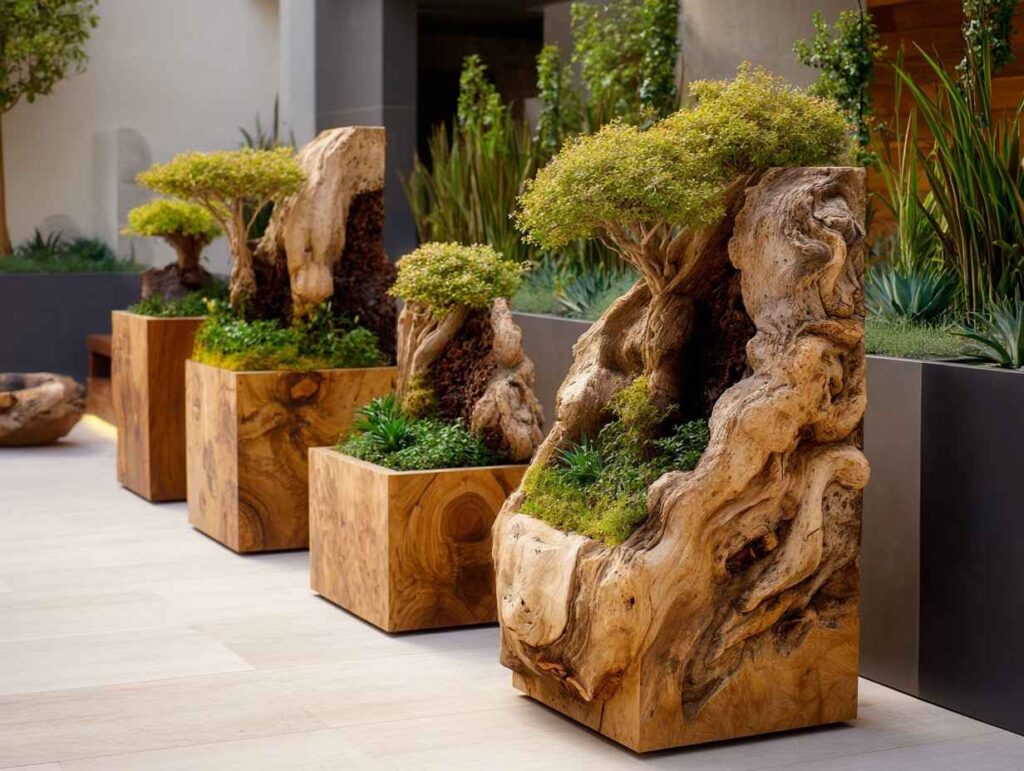
Nature’s own ruin garden. This quartet of planters is hewn from storm-felled Pacific yew roots—each a 90 cm × 45 cm × 45 cm monolith exhumed from Oregon riverbanks after a century of erosion. The wood is left raw, its surfaces pocked with worm trails, lichen scars, and hollowed cavities that once cradled river stones. Artisans merely square the base for stability and bore a 15 cm deep planting chamber into the crown, preserving every twist and crevice. A thin epoxy veil seals the interior against rot while leaving the exterior untouched; drainage is handled by the wood’s natural fissures, which funnel water into a hidden 5-liter sub-base reservoir.
The photo stages an atrium procession: the lead grotto cradles a Buxus sinica bonsai whose canopy mirrors the root’s ancient silhouette; the second hosts a miniature forest of Selaginella kraussiana and Pteris ensiformis; the third erupts with Asplenium nidus ferns spilling from a hollowed trunk; the fourth is a vertical rock garden of Crassula ovata and Rhipsalis baccifera. The yew’s silvered patina glows under skylight, each planter a fossilized wave frozen mid-crash.
Why it works: The grottoes are instant archaeology—perfect for biophilic lobbies, spa entrances, or as solitary meditation objects. The cavities invite epiphytic orchids (Phalaenopsis mini), air plants (Tillandsia ionantha), and moss (Leucobryum glaucum) to colonize the wood itself. Group in a loose arc to mimic a river bend or isolate one as a living plinth. Plant pairing tip: Embrace the ruin—let Ficus pumila climb the crevices, or stage a kokedama Pilea glauca in a hollow. Durability note: Yew is denser than oak and naturally rot-resistant (heartwood lasts 1,000+ years in soil). These will petrify further outdoors—100 years is merely their second act.
Design 11: The Seamless Acacia Horizon
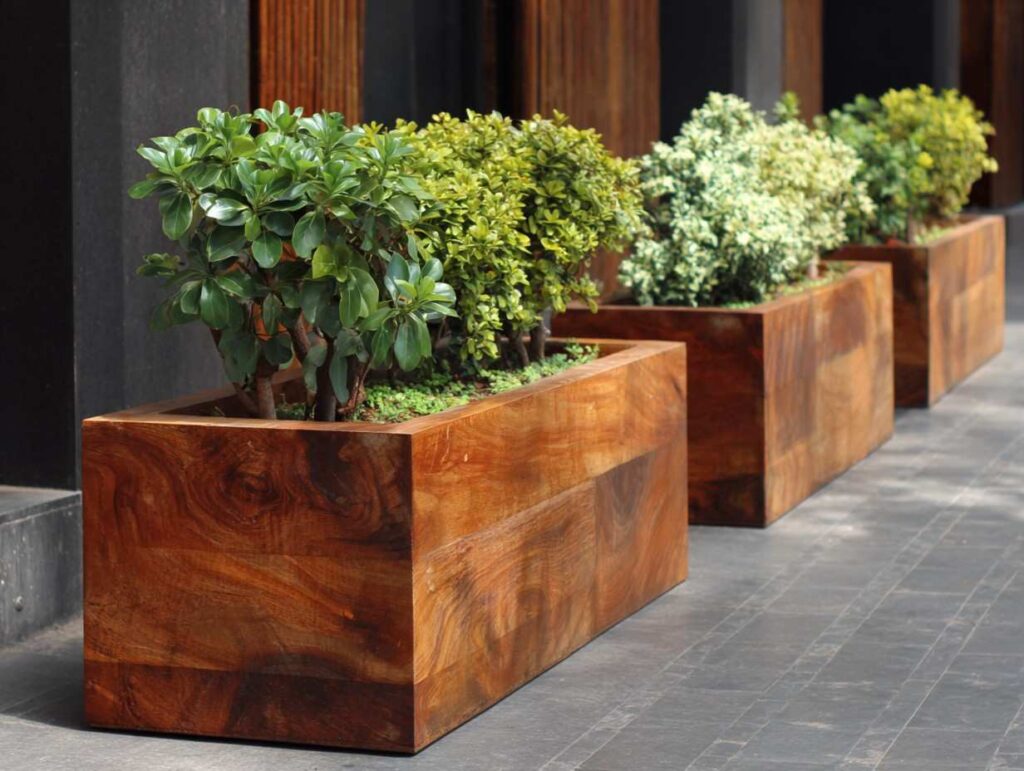
A study in liquid wood. These 180 cm × 50 cm × 60 cm troughs are steam-bent from a single 8 mm-thick slab of Australian black acacia—kiln-dried, then bent around a heated mandrel to form a continuous, jointless curve on all four corners. The result is a flowing rectangle with no visible seams, edges, or screws; only the hypnotic flame grain that wraps the box like a ribbon. A 3 cm raised lip hides an internal galvanized liner with laser-cut perforations for drainage, while four recessed casters (lockable) allow the 120 kg unit to glide silently across marble or stone.
The photo captures a corporate forecourt parade: the lead trough cradles a Schefflera arboricola umbrella tree underplanted with Soleirolia soleirolii (baby’s tears); the second hosts graduated Pittosporum tenuifolium ‘Silver Sheen’ spheres; the third overflows with Liriope muscari ‘Variegata’. The acacia’s deep cherry tone deepens to oxblood in sunlight, reflecting on the polished floor like a lacquered mirror.
Why it works: The seamless form is pure luxury—perfect for hotel lobbies, executive terraces, or as mobile green dividers in open-plan offices. The casters enable seasonal rotation (sun-chasing in winter, shade-seeking in summer) without lifting. Line six end-to-end for a 10-meter living hedge or stagger in pairs to frame a sculpture. Plant pairing tip: Go gradient—plant tall Dracaena reflexa ‘Song of India’ at the ends, mid-height Cordyline fruticosa in the center, and low Chlorophytum comosum spilling over the lip. Durability note: Acacia’s interlocking grain resists splitting; the steam-bent structure is stronger than solid wood. With UV-inhibiting oil annually, the horizon will glow for 35+ years.
Design 12: The Sculpted Vortex Urn
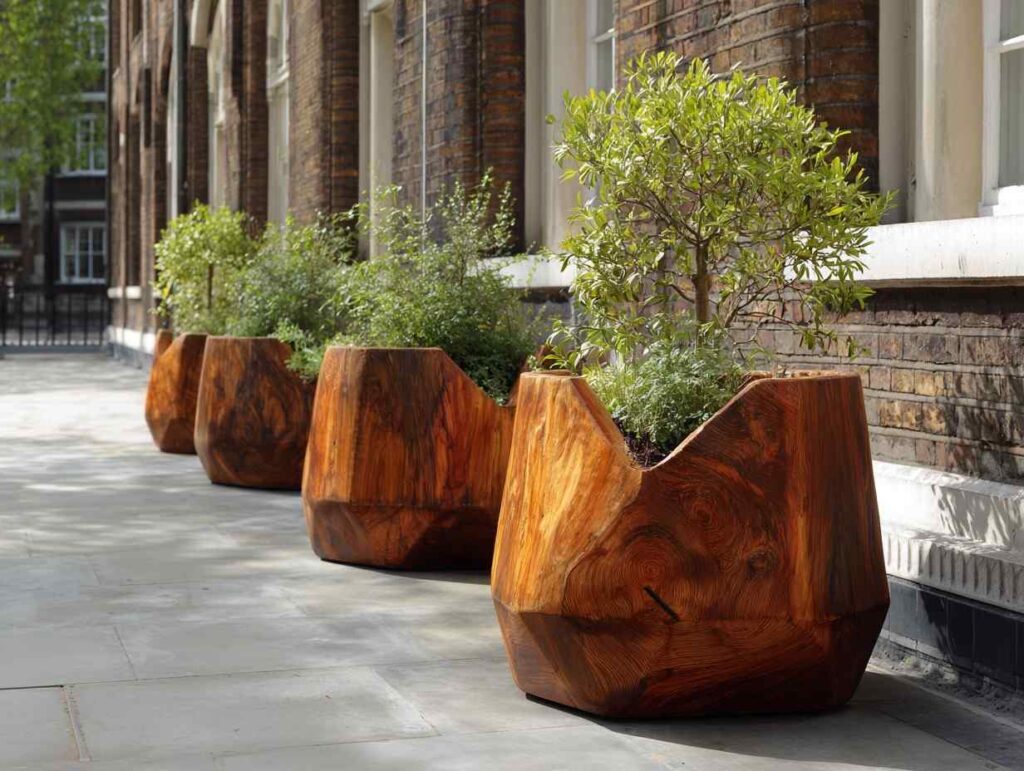
A vortex frozen in elm. Each 75 cm tall × 55 cm diameter urn is carved from a single storm-downed English elm burl, its wild grain spiraling inward like a galaxy caught mid-rotation. CNC roughing removes 60 % of the mass, then master carvers chase the contours by hand, leaving a scooped, asymmetrical mouth that dips 25 cm on one side and rises 15 cm on the other—creating a natural spillway for trailing plants. The interior is hollowed to a 40 cm deep cavity lined with marine-grade fiberglass; a 360° micro-perforated drainage ring sits flush with the base, invisible beneath a layer of charcoal grit.
The photo lines a Bloomsbury sidewalk: five urns march past Georgian brick, the lead vessel cradling a Prunus lusitanica standard with Vinca minor ‘Alba’ cascading from the low lip; the second hosts Artemisia ‘Powis Castle’ silver fountains; the third erupts with Fatsia japonica ‘Spider’s Web’; the fourth is a fern grotto of Polystichum setiferum; the fifth spills Hedera helix ‘Glacier’. The elm’s fiery crotch grain ignites in sunlight, each urn a unique fingerprint of the tree’s heart.
Why it works: The vortex mouth is genius—it frames plants like a proscenium arch, turning modest greenery into theatrical vignettes. The asymmetry invites rotation: face the low side toward the path in summer for maximum spill, spin it in winter to shield tender roots. Cluster in odd numbers for organic rhythm or isolate one as a doorstep sentinel. Plant pairing tip: Lean into the drama—pair upright Cordyline australis ‘Red Star’ with Ajuga reptans ‘Black Scallop’ pouring from the scoop. Durability note: Elm burl is denser than steel by volume; the fiberglass liner laughs at freeze-thaw cycles. With tung oil every 18 months, the vortex will spin for 60+ years.
Practical Guide: How to Choose, Plant & Maintain Your Dream Wooden Planter
You’ve met the twelve masterpieces. Now let’s turn inspiration into action. This distilled playbook—drawn from landscape architects, master carpenters, and urban horticulturists—ensures your chosen planter thrives for decades, not seasons.
1. Match Scale & Function to Space
| Space | Ideal Designs | Why |
|---|---|---|
| < 1 m² (balcony, windowsill) | 5 (Fractured Prism), 9 (Walnut Monoliths), 12 (Vortex Urn) | Compact footprint, high visual impact |
| Pathways & entrances | 1 (Stacked Horizon), 4 (Vertical-Ribbed), 11 (Seamless Acacia) | Linear rhythm, pedestrian flow |
| Rooftops & terraces | 7 (Modular Mosaic), 8 (Polyhedral Cloud), 2 (Faceted Boulder) | Wind-stable, reconfigurable |
| Indoor atriums | 3 (Charred Cube), 10 (Driftwood Grotto) | Dramatic height, biophilic acoustics |
Pro move: Measure twice—leave 15 cm clearance around each planter for root expansion and airflow.
2. Wood Type Cheat Sheet
| Wood | Janka Hardness | Best Climate | Aging Path | Maintenance |
|---|---|---|---|---|
| Iroko | 1,260 | Coastal, high UV | Golden → silver | Oil yearly |
| Cumaru | 3,500 | Arid, desert | Red → chocolate | Oil biannual |
| Reclaimed Oak | 1,200 | Temperate | Raw → silver patina | Oil every 18 mo |
| Teak | 1,070 | Tropical, humid | Honey → grey | Oil yearly |
| Elm Burl | 1,300+ | All | Flame → fossilized | Oil every 2 yrs |
| Shou Sugi Ban Cypress | 1,020 | All | Charred → velvet black | None (self-preserving) |
Sustainability note: All designs prioritize FSC-certified, reclaimed, or storm-felled timber. Ask for chain-of-custody certificates.
3. The Universal Planting Formula: Thriller + Filler + Spiller
- Thriller (1 focal plant, 60–150 cm)
- Outdoor: Olea europaea bonsai, Cordyline australis ‘Red Star’, Podocarpus macrophyllus
- Indoor: Ficus lyrata, Dracaena reflexa ‘Song of India’
- Filler (3–5 mid-height, 30–60 cm)
- Heuchera ‘Palace Purple’, Pittosporum ‘Golf Ball’, Sedum ‘Angelina’
- Spiller (trailing, 30+ cm)
- Vinca minor, Helichrysum petiolare, Soleirolia soleirolii (baby’s tears)
Succession trick: Plant spring bulbs (Narcissus ‘Tête-à-Tête’) beneath spillers for winter surprise.
4. Maintenance Calendar (5 Minutes Per Month)
| Season | Task | Tool |
|---|---|---|
| Spring | Oil exterior, refresh 5 cm topsoil, divide perennials | Boiled linseed oil, trowel |
| Summer | Check drainage holes, rotate 90° for even sun, deadhead | Pipe cleaner, spirit level |
| Autumn | Prune spillers, add slow-release osmocote, mulch with cocoa shells | Felco pruners, 14-14-14 granules |
| Winter | Elevate 2 cm on pot feet (frost protection), wrap base in burlap if < -5°C | Rubber pot risers |
Tech upgrade: Insert Blumat® capillary cones in Designs 1, 3, 11 for 2-week watering autonomy.
5. Hidden Tech & Customization
- Sub-irrigation spikes → Designs 1, 3, 7, 11 (fill reservoir, forget for 14 days)
- LED grow strips → Recess into tall cubes (Designs 3, 9) for 12-hour winter light cycle
- Magnetic plant tags → Snap onto modular units (Designs 7, 8) for rotating labels
- Smart drainage → Add Bluetooth soil-moisture sensors; app alerts when < 20 %
6. Budget Reality Check
- Entry (reclaimed pine DIY): $150–$300 per unit
- Mid (teak, custom joinery): $800–$2,000
- Bespoke (burl, CNC): $3,000+ (Designs 10, 12)
Cost-saving hack: Start with Design 7 (Modular Mosaic)—buy 6 cubes, stack as budget allows.
Epilogue: Choosing Your Wooden Legacy
Twelve designs, twelve philosophies—yet all share the same DNA: wood that breathes, ages, and improves with time. From the Stacked Horizon Trough’s quiet authority to the Sculpted Vortex Urn’s wild poetry, each planter is a pact between craftsman, tree, and gardener. Select by mood (minimalist, brutalist, romantic), by function (modular, mobile, monumental), or by narrative (reclaimed, steam-bent, storm-forged). Maintain with love—oil, rotate, prune—and these vessels will outlast trends, mortgages, even the buildings they guard. In a world of disposable plastic, a wooden planter is rebellion: slow, deliberate, alive. Plant one, and watch the street, the terrace, the soul—transform.